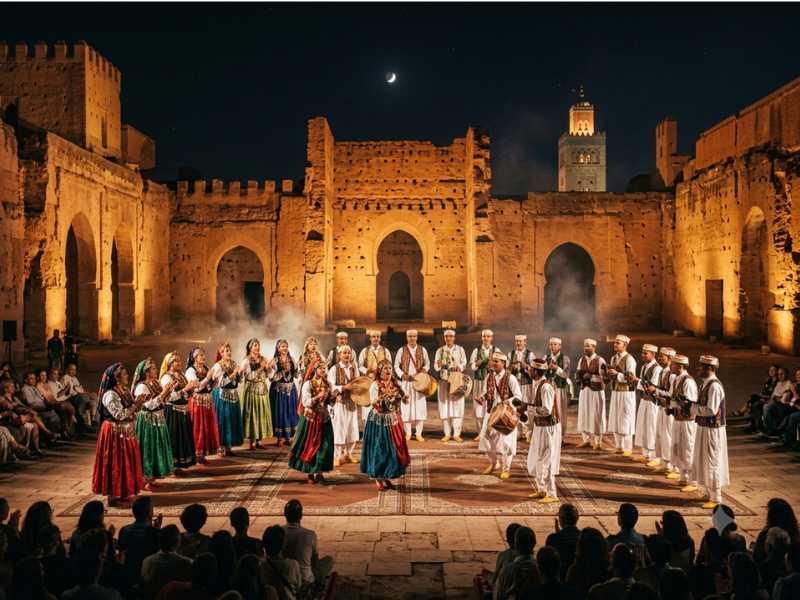

Marrakech Shines: The National Festival of Popular Arts is Back!
Every summer, when the sun blazes high over the Red City, Marrakech transforms into something even more magical than usual. The air fills not just with heat, but with the syncopated rhythm of bendir drums, the high-pitched wail of ghaitas (oboes), and the hypnotic, clattering dance of qraqeb (metal castanets).
This is the season of the Festival National des Arts Populaires (FNAP), Morocco’s oldest and most significant celebration of intangible cultural heritage. If you want to witness the true heartbeat of the Kingdom, this July is the time to be in Marrakech.
🏺 A Legacy of Cultural Unity
Founded in 1960 by King Mohammed V, the FNAP was created with a profound purpose: to preserve, showcase, and celebrate the incredibly diverse folkloric traditions that make up Moroccan identity.
For over six decades, it has served as a bridge between generations, ensuring that ancient dances, songs, and rituals—passed down through oral tradition in remote mountains and desert oases—are not lost to modernity. It is a spectacular gathering of the Kingdom’s “living treasures.”
🎭 The 2026 Edition: A Journey Through Sound and Color (This July!)
Taking place right now, this July 2026, the 61st edition of the festival has turned the historic landmarks of Marrakech into open-air stages.
This year’s festival continues the tradition of showcasing the two primary pillars of Moroccan popular art:
1. The Dynamic Range of Ahwash and Ahidus
From the High Atlas and the Anti-Atlas come the powerful group dances.
- Ahwash: Witness hundred-strong troupes of men and women performing complex, synchronized circle dances in vibrant tribal costumes, accompanied by a deafening chorus of frame drums.
- Ahidus: Explore the softer, more poetic call-and-response traditions of the Middle Atlas, where warriors and women dance with mesmerizing symmetry.
2. The Mysticism of Gnawa and Sufi Rituals
The festival wouldn’t be complete without the spiritual sounds that define Marrakech.
- Gnawa: Lose yourself in the deep, low thrum of the gimbri (three-stringed lute) and the acrobatic, ecstatic leaps of the Gnawa Maâlems, clad in their shell-encrusted costumes.
- Sufi Brotherhoods: Watch the mesmerizing, spinning dances of the Hamadcha or Aissaoua orders, whose performances are both a spectacle and a spiritual trance.
🌅 A Venue Like No Other: El Badi Palace
The heart of the festival remains the majestic ruins of the El Badi Palace. As twilight deepens into night, the 16th-century ramparts are illuminated, creating a breathtaking backdrop. There is nothing quite like watching a 100-person Ahwash troupe perform in the sunken gardens where sultans once walked.
Leave a Reply