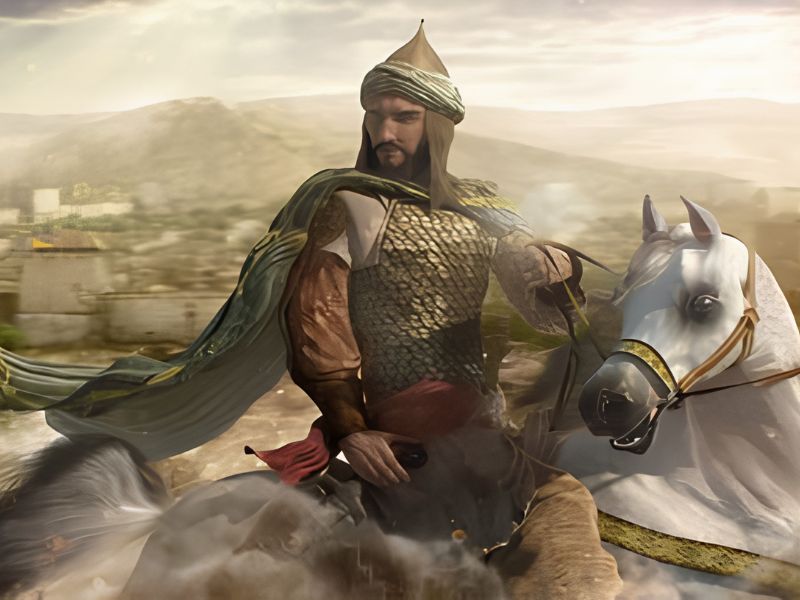

If Abd al-Mu’min was the architect of the Almohad Empire, then Abu Yusuf Yaqub al-Mansur (reigned 1184–1199) was its golden sun. Under his rule, the Almohad Caliphate reached its absolute zenith, becoming the most powerful, culturally sophisticated, and intellectually vibrant state in the western world.
Known as Al-Mansur Billah (The Victorious by God), he was a ruler who balanced the iron fist of a conqueror with the delicate hand of a patron of the arts and philosophy.
Taking the throne during a time of renewed pressure from the Christian kingdoms of the north and internal unrest, Yaqub al-Mansur solidified the Almohad legacy through massive construction projects and one of the most famous military victories in Islamic history.
🏺 The Victor of Alarcos
In 1195, Al-Mansur faced a massive challenge at the Battle of Alarcos.
- The Military Triumph: He led his Moroccan forces across the Strait to face King Alfonso VIII of Castile. His crushing victory reshaped the map of Al-Andalus and pushed the borders of the Caliphate back to the gates of Toledo.
- The “Victorious” Title: It was this battle that earned him the title Al-Mansur. He returned to Morocco not just as a king, but as a legendary defender of the faith.
🏛️ The Master Builder of Red Towers
Al-Mansur’s passion for architecture gave Morocco its most iconic symbols. He was the man who perfected the “Almohad Style”—massive, geometric, and impossibly elegant.
- The Giralda (Seville): He completed the stunning minaret of the Great Mosque of Seville, which remains the heart of the city today.
- The Koutoubia (Marrakesh): While begun by his grandfather, it was Al-Mansur who completed the tower we see today, adding the golden orbs and the intricate lattice-work.
- The Hassan Tower (Rabat): His most ambitious project was the Mosque of Hassan in Rabat, intended to be the largest mosque in the world. Though left unfinished at his death, its lonely minaret remains a symbol of Morocco’s imperial reach.
- Udayas Kasbah: He rebuilt the majestic gate of the Kasbah of the Udayas, turning a military fortress into a work of art.
📜 A Sanctuary for the Mind
Al-Mansur’s court was the intellectual capital of the world. He was a deeply pious man who nonetheless protected and funded the era’s greatest philosophers.
- Averroes (Ibn Rushd): He was the patron of the legendary philosopher Averroes, whose commentaries on Aristotle would later spark the Renaissance in Europe.
- Medicine & Charity: He founded grand hospitals (Bimaristans) in Marrakesh and Rabat that were free to the public, proving that his vision of “Unity” extended to the welfare of his people.
Leave a Reply