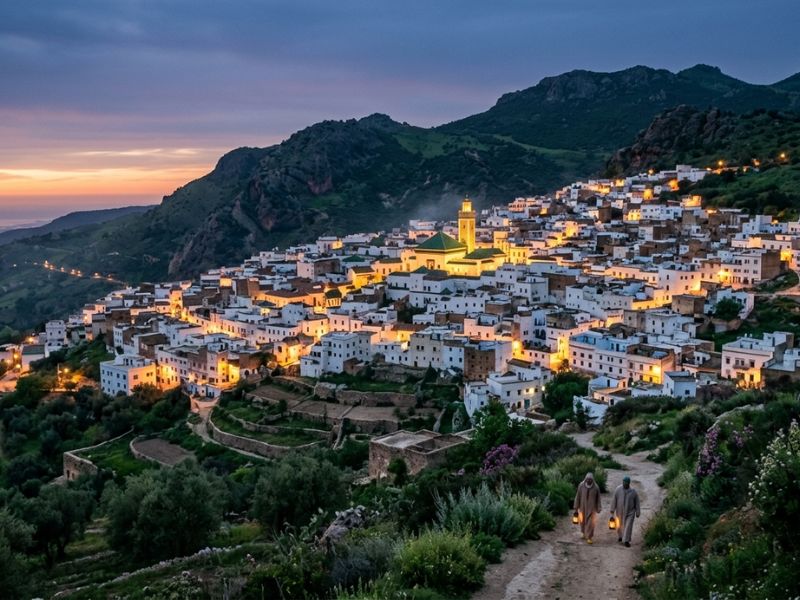

In the misty foothills of the Zerhoun Mountains, not far from the Roman ruins of Volubilis, lies a town that is the spiritual heartbeat of a nation. This is Moulay Idriss Zerhoun, the final resting place of the man who planted the seeds of the Moroccan state: Moulay Idriss I.
To understand Morocco is to understand Idriss I. He was not just a king; he was the bridge between the East and the West, the ancient and the Islamic, and the disparate tribes that would become a unified kingdom.
The story of Moulay Idriss I (Idris ibn Abdallah) is a saga of survival, faith, and diplomacy. A great-great-grandson of the Prophet Muhammad, he fled the Abbasid Caliphate in Baghdad following the Battle of Fakhkh, eventually seeking refuge in the far “Maghreb al-Aqsa” (the Farthest West).
🏺 The Arrival: From Volubilis to Zerhoun
When Idriss arrived in 788 AD, he didn’t find a void; he found a complex landscape of Berber tribes.
- The Awraba Alliance: Instead of conquering by the sword, Idriss won the hearts of the Awraba tribe. They recognized his lineage and his wisdom, electing him as their Imam and leader.
- A New Synthesis: This alliance marked the birth of the Idrisid Dynasty. It was a unique fusion of Arab Islamic tradition and indigenous Amazigh (Berber) strength—the very DNA of Moroccan identity.
🏰 Founding the First Capital
While his son, Idriss II, would eventually establish Fez, it was Idriss I who laid the foundations. He began his rule in the Roman city of Volubilis before moving to the more defensible heights of the Zerhoun Massif.
- The Sacred Town: Today, the town of Moulay Idriss Zerhoun is built across two hills, cradling his mausoleum. For centuries, it was considered so holy that non-Muslims were not permitted to stay overnight—a rule that only changed in the mid-20th century.
🕯️ The Legacy of the “Founder”
Idriss I’s reign was short—he was tragically assassinated by an envoy of the Abbasid Caliph in 791 AD—but his impact was eternal.
- Sovereignty: He established the first central authority in Morocco independent of the Eastern Caliphates.
- Unity: He brought together North African tribes under a single spiritual and political banner, creating the first recognizable Moroccan state.
Leave a Reply