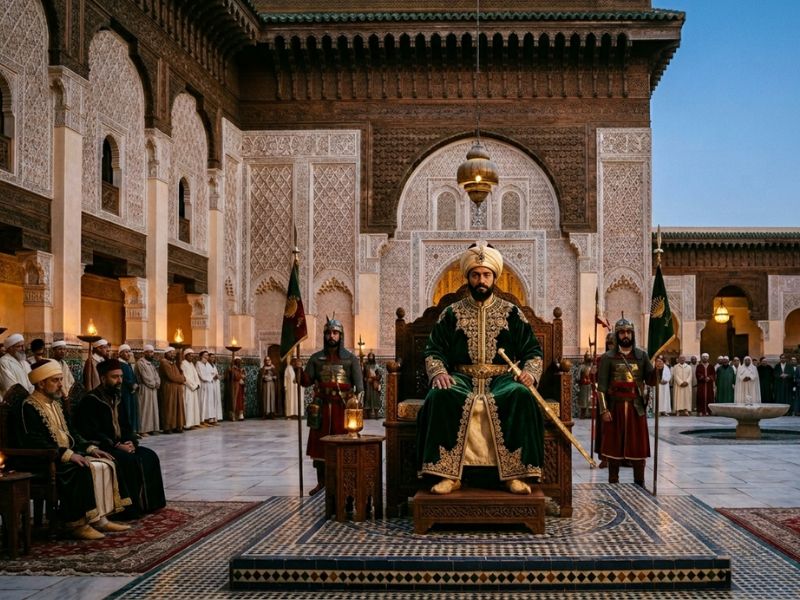

The mid-14th century in Morocco was defined by a single, formidable figure who sought to cement the Marinid Dynasty as the intellectual and spiritual center of the Islamic world. That man was Sultan Abu Inan Faris (reigned 1348–1358).
He was not just a monarch; he was a scholar, a poet, and an obsessive builder whose legacy still dictates the skyline of Fez today.
Abu Inan Faris took the throne during a period of intense transition. He was a ruler of grand ambitions, attempting to reunify the Maghreb and position himself as the supreme Caliph. To justify this power, he invested heavily in intellectual soft power, commissioning monuments that proved Morocco was the true guardian of civilization.
🏺 The Visionary of the Medersa Bou Inania
Completed in 1357, the Medersa Bou Inania is considered the pinnacle of Marinid architecture. Abu Inan did not just fund it; he obsessed over its perfection.
- The “Grand” Medersa: Unlike other schools, it was designed to function as both a university and a congregational mosque (Juma’a), a rare honor.
- The Purifying Act: Legend says that when Abu Inan saw the astronomical bill for the building’s construction, he threw the account books into the river, saying: “A thing that is beautiful is not expensive, no matter how much it costs.” He believed that beauty was a form of worship.
- Architectural DNA: He demanded the most intricate zellij (mosaic tile), hand-carved cedarwood, and “lace-like” stucco, creating a style that has defined Moroccan luxury for over 600 years.
⚙️ The Patron of Science: Dar al-Magana
Abu Inan Faris was fascinated by the “Exact Sciences.” By commissioning Dar al-Magana (The Water Clock) directly opposite his Medersa, he made a public statement:
- Time as Law: The Sultan wanted the city to move in perfect synchronization. The water clock ensured that the entire Medina followed the same schedule for prayer and trade.
- Technological Superiority: By hiring the era’s greatest engineers (like el-Tlemsani), he proved that his court was the most advanced in North Africa.
📜 The King Who Chronicled the World
Perhaps Abu Inan’s greatest contribution to global history was his patronage of the legendary traveler Ibn Battuta.
- When Ibn Battuta returned to Morocco after 24 years of travel, it was Abu Inan Faris who commanded him to dictate his memoirs.
- The Sultan provided a royal scribe, Ibn Juzayy, to write down the Rihla (The Travels). Without Abu Inan’s vision, the world’s most famous medieval travelogue might have been lost to time.

Leave a comment