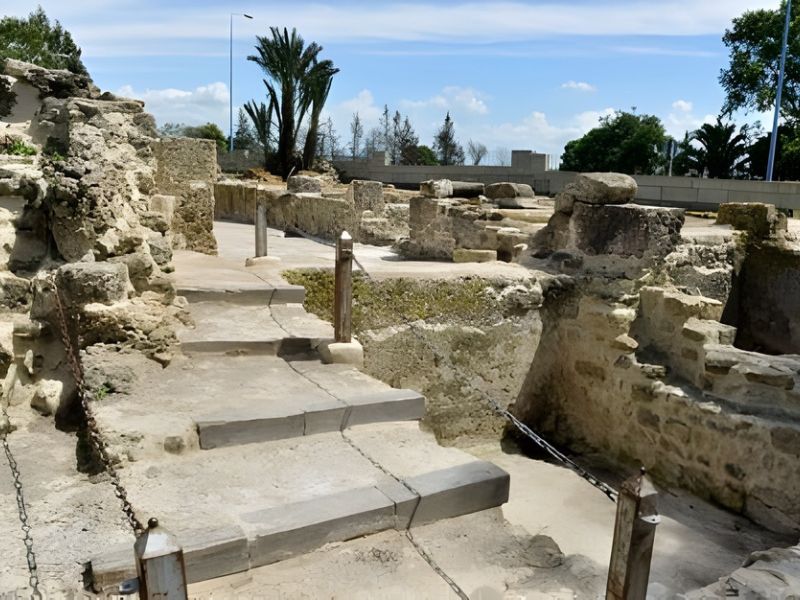

Perched on a sun-drenched hill overlooking the meandering Loukkos River and the salt marshes of Larache, the Roman Ruins of Lixus stand as a testament to Morocco’s deep antiquity. Long before the great battles of the 16th century, Lixus was a legendary powerhouse—a place where history and mythology blur into one.
Legend has it that this was the site of the Garden of the Hesperides, where Hercules performed one of his twelve labors by plucking the golden apples. Today, it remains one of the oldest and most significant archaeological sites in North Africa.
Founded by the Phoenicians in the 7th century BC and later expanded by the Romans, Lixus was a thriving industrial and religious hub. Unlike the landlocked Volubilis, Lixus was a maritime city, its wealth built on the bounty of the Atlantic.
🏺 The Industrial Giant: Garum and Gold
Lixus wasn’t just a city of temples; it was a city of industry.
- The Salt-Fish Factories: Lixus was the largest producer of Garum (a fermented fish sauce) in the Roman Empire. You can still see the massive stone vats where fish were salted and fermented before being shipped to the dinner tables of Rome.
- The Amphitheatre: Lixus boasts one of the very few Roman amphitheatres in North Africa that features a circular arena. Interestingly, it wasn’t just for gladiators—it was also used as a theater and for water-based spectacles.
- The Acropolis: At the summit of the hill, the religious complex offers a panoramic view of the Atlantic. Here, temples dedicated to various deities stood as beacons for ancient sailors entering the river mouth.
🛠️ A Modern Revival: The 2026 Experience
For years, Lixus was a “hidden” gem, but recent preservation efforts have transformed it into a world-class archaeological park:
- The New Interpretation Center: A sleek, modern museum at the entrance now houses incredible mosaics and artifacts, providing the context needed before you hike the hill.
- Walking Trails: Clearly marked paths lead you through the three main sectors: the industrial quarter, the residential villas with their intricate floor mosaics, and the sacred acropolis.
- Archaeology in Action: In 2026, visitors can often witness live excavations, as teams continue to uncover the Punic layers hidden beneath the Roman stone.
📍 Why it Outshines the Rest
While Volubilis is grander in scale, Lixus offers a haunting, atmospheric beauty. Standing among the columns as the Atlantic wind whistles through the stone, looking down at the very river where Phoenician galleys once docked, creates a connection to the past that is visceral and raw.

Leave a comment