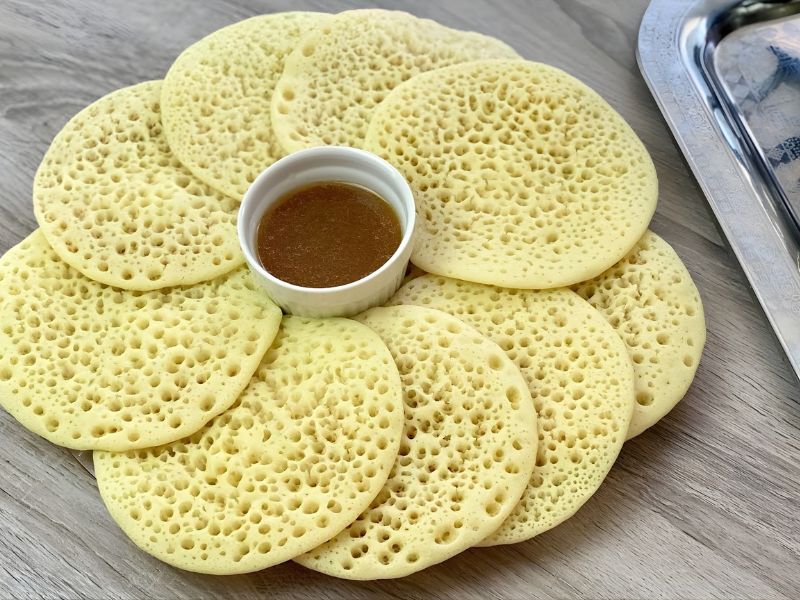
If you have ever looked at a Moroccan breakfast table and wondered why there are pancakes that look like they’ve been sculpted from honeycomb, you have found the Baghrir.
Known famously as the “Thousand-Hole Pancake,” Baghrir is a marvel of culinary physics. It is a light, spongy, and incredibly airy semolina pancake that is cooked only on one side. This unique process creates hundreds of tiny craters on the surface—each one a perfect little vessel designed to trap a golden sea of honey and melted butter.
Baghrir is a staple of the Moroccan Ftour (Iftar) during Ramadan and a beloved weekend breakfast treat. While it looks like a complex piece of lace, its beauty lies in the simple chemistry of its batter.
🏺 The Science of the “Craters”
Unlike American pancakes or French crepes, Baghrir relies on a thin, yeasted semolina batter.
- The Yeast Factor: As the batter hits a hot, non-stick griddle, the yeast reacts instantly, sending bubbles to the surface.
- The One-Side Rule: Baghrir is never flipped. It cooks until the top is dry and set, leaving the “thousand holes” open and ready to absorb whatever syrup you pour over them.
- The Texture: Because it isn’t flipped, the bottom remains smooth and slightly golden, while the top is soft, pale, and incredibly porous.
🥘 The Essential “Honey-Butter” Bath
In Morocco, Baghrir is rarely eaten plain. It is a vehicle for the most decadent of toppings:
- The Classic: A warm mixture of melted butter and pure honey. As you pour it over, the syrup disappears into the holes, saturating the entire pancake.
- The Nutty Twist: Some families serve it with Amlou (the Moroccan almond, honey, and argan oil spread) for a rich, earthy flavor.
- The Tea Pairing: There is no better companion for Baghrir than a steaming glass of Moroccan Mint Tea. The bitterness of the tea cuts through the floral sweetness of the honey-soaked semolina perfectly.
📍 Why Baghrir is a “Good Omen”
In Moroccan folklore, the success of the Baghrir (meaning how many holes it develops) is often seen as a sign of the cook’s “Baraka” or blessing. If the holes don’t form, it’s said that someone gave the batter the “evil eye”! Don’t worry, though—in 2026, modern blenders have made getting those perfect holes easier than ever.

Leave a comment