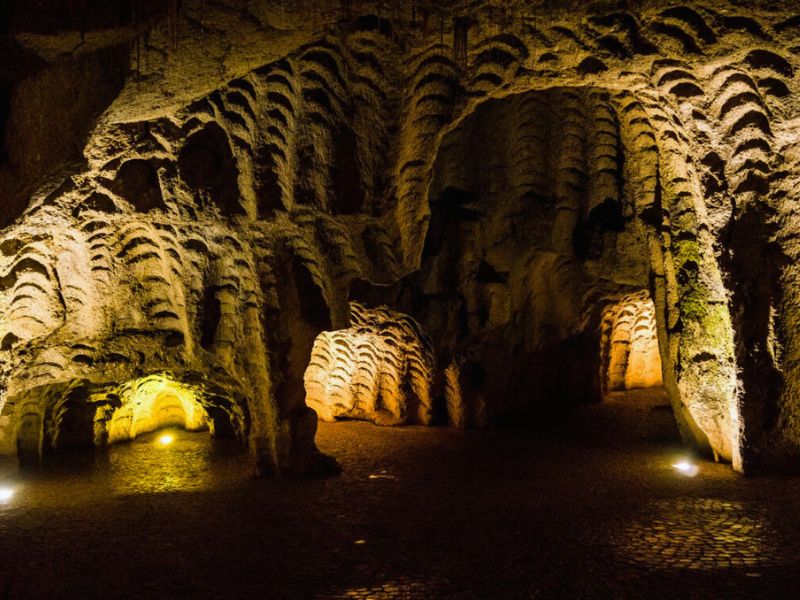

Perched where the Mediterranean kisses the Atlantic, just 14 kilometers west of Tangier, lies a place where the boundaries between myth and geology dissolve. The Caves of Hercules (Grottes d’Hercule) are more than just a natural wonder; they are a symbolic gateway to Africa and a cornerstone of Greek mythology.
Whether you are standing before the iconic “Map of Africa” opening or exploring the limestone chambers once used by ancient civilizations, these caves offer a sensory journey through time.
Stepping into these caves is like entering a sanctuary carved by the hands of a demigod. As of 2026, the site remains one of Morocco’s most visited landmarks, recently restored to preserve its haunting beauty and structural integrity.
🏺 Why are they called the “Caves of Hercules”?
The name is rooted in the 12 Labors of Hercules. According to Greek mythology, the hero was tasked with stealing the golden apples from the Garden of the Hesperides (believed by many ancient writers to be nearby).
- The Resting Place: Legend says Hercules rested in these very caves before embarking on his task.
- The Pillars of Hercules: A more dramatic version of the myth suggests that instead of climbing the mountains that blocked his path to the Atlantic, Hercules used his superhuman strength to smash through them. This act allegedly created the Strait of Gibraltar, with the “Pillars” being the Rock of Gibraltar in Europe and Jebel Musa in Morocco.
📍 What to Explore Inside
The cave system is a fascinating hybrid of natural limestone erosion and human intervention:
- The “Map of Africa” Opening: The most famous feature is the sea-facing entrance. Viewed from inside the cave, the silhouette of the opening perfectly mirrors the shape of the African continent. This “mirrored Africa” frames the turquoise waves of the Atlantic, creating one of the most photographed spots in Morocco.
- The Phoenician Eye: Look for markings on the walls that resemble eyes; these are believed to be ancient navigation maps or religious symbols left by Phoenician sailors.
- The Millstone Quarries: For centuries, Berber populations used the cave walls to cut circular millstones. This process left behind a striking, “scalloped” pattern on the cave walls that looks like modern architectural design.
- The Underwater Secret: Local lore whispers that the caves are part of a 24km subterranean tunnel that passes beneath the sea and emerges at St. Michael’s Cave in Gibraltar. While unproven, the legend keeps the “Pillars of Hercules” connection alive.
🧭 Pro Tips for 2026 Visitors
- The Golden Hour: Visit just before sunset. The light pouring through the “Map of Africa” creates a golden silhouette effect that is breathtaking.
- Combine with Cap Spartel: The caves are only 5km from Cap Spartel, the northwesternmost point of Africa. Make it a half-day trip to see the 19th-century lighthouse.
- Footwear: The cave floors are often damp and slippery from sea spray. Wear sturdy, non-slip shoes!

Leave a comment