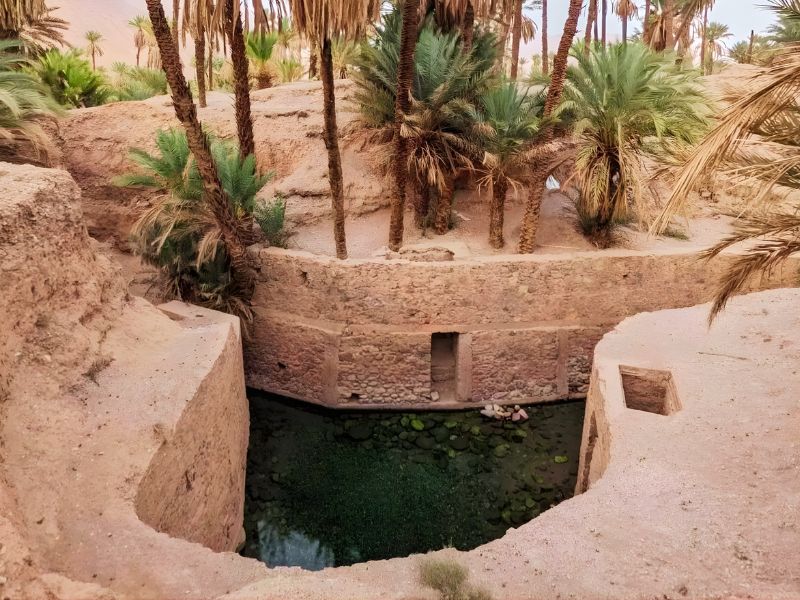

In the arid plains of southern Morocco, where the sun reigns supreme and surface rivers are often nothing more than dry stone beds, life depends on a “secret river” flowing beneath the earth.
This is the Khettara system—a masterpiece of ancient hydraulic engineering that turned the desert green and allowed great civilizations to flourish in the most inhospitable environments on earth.
❓What is Khettara system?
A Khettara is a gravity-fed underground irrigation channel designed to tap into the water table at the foot of mountains and transport it across kilometers of dry land to the heart of an oasis.
While the concept originated in ancient Persia (where it is known as a Qanat), the Moroccans—particularly during the Almoravid dynasty in the 11th century—perfected the art. They used it not just for farming, but to supply the fountains and gardens of legendary cities like Marrakesh.
🏗️ How Does a Khettara Work? (The Engineering)
The genius of the Khettara lies in its simplicity and sustainability:
- The Mother Well: Engineers first dig a deep “mother well” into an aquifer (usually near the foothills of the Atlas or Anti-Atlas).
- The Tunnel: A horizontal tunnel is then excavated with a very precise, slight downward slope (usually 1% to 2%). This allows the water to flow by gravity without the need for pumps.
- The Shafts: If you fly over southern Morocco, you will see long lines of mounds that look like “giant molehills.” These are the vertical shafts used for ventilation and to remove debris during construction and maintenance.
- The Outlet: Once the tunnel reaches the oasis, the water emerges into the open air, where it is distributed through a complex network of surface canals called seguias.
🌴 Why Khettaras Are the Key to Oasis Prosperity
Without the Khettara, the great palm groves of the Tafilalt, Draâ, and Skoura would likely not exist.
- Evaporation-Proof: By keeping the water underground, the system prevents the massive loss that would occur under the scorching Saharan sun.
- Community & Law: The Khettara created a unique social structure. Water rights were traditionally managed by a “Water Master” (Agherrab) and distributed using an ancient water-clock system (often a pierced copper bowl floating in water).
- Sustainable Extraction: Unlike modern deep-well pumps that can deplete aquifers, a Khettara only takes what the earth naturally provides through gravity, maintaining a delicate ecological balance for over a thousand years.
📍 Where to Explore the Khettaras Today
While many systems have gone dry due to modern motorized pumps, several regions have preserved these “water cathedrals”:
- Jorf & Fezna (Near Erfoud): This is the best place for tourists. You can actually descend into a restored Khettara and walk through the cool, dark tunnels to see the engineering firsthand.
- Tighmert Oasis (Guelmim): Here, the traditional irrigation culture is still alive, and you can see how the water is distributed to the family gardens.
- The Living Ecomuseum of Khettaras: Located in Fezna, this museum explains the history, social laws, and the technical marvel of the system.

Leave a comment