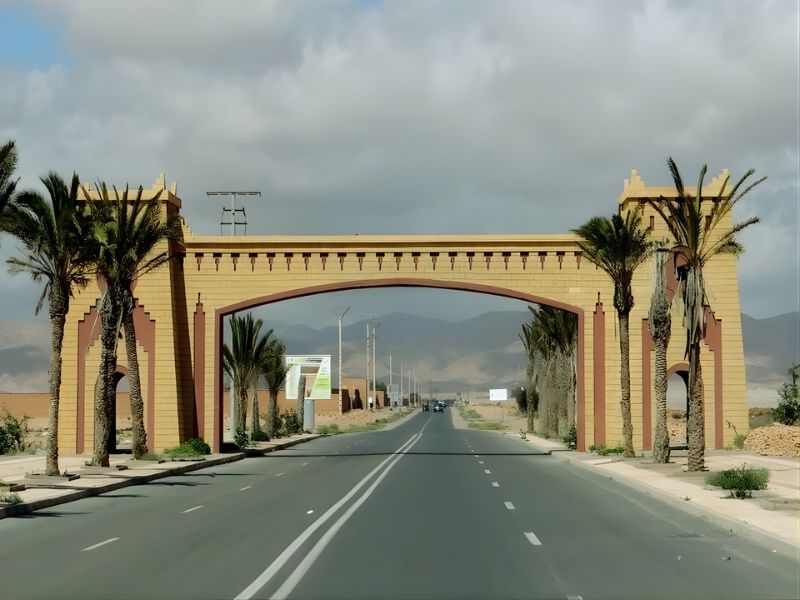
Guelmim is the point where the world changes. As you cross the city limits, the landscape shifts from the rugged foothills of the Anti-Atlas to the vast, open silence of the Sahara.
Known historically as the “Gateway to the South,” Guelmim was once a vital stop on the trans-Saharan trade route connecting Timbuktu to the north. Today, it remains the ultimate base for travelers who want to witness the authentic nomadic soul of Morocco, where Hassani culture thrives and the “Blue Men” still trade in ancient market squares.
Guelmim is a city of ochre-red walls and deep-green palm groves, but its true beauty lies in its role as a cultural bridge. It is here that you leave the Berber-influenced north and enter the land of the Sahrawi people.
🌍 Geography: Where the Desert Meets the Sea
Guelmim sits at a unique geographical crossroads:
- The Desert Fringe: To the south and east lies the stony “Reg” desert and the first rolling dunes of the Sahara.
- The Atlantic Coast: Just 60km west, the desert literally falls into the ocean at the legendary Plage Blanche (White Beach).
- The Oasis Belt: The city is encircled by thousands of date palms, with the Tighmert Oasis serving as its lush, green lungs.
🏺 Cultural Highlights: The Land of the “Blue Men”
The people of Guelmim are famous for their hospitality and their distinct Sahrawi heritage.
- The “Blue Men”: The local nomads are often called “Blue Men” because of their indigo-dyed Daraa (robes). The dye famously rubs off on their skin, giving it a bluish tint that was historically seen as a mark of status and protection from the sun.
- The Guedra Dance: This is the spiritual heartbeat of the region. A solo female dancer, veiled and kneeling, performs intricate movements with her hands and fingers to the rhythmic beat of a “Guedra” (a kitchen pot turned drum). It is a hypnotic ritual meant to spread positive energy to the onlookers.
- Traditional Dress: Women wear the Melhfa, a colorful, single piece of fabric draped elegantly around the body, while men wear the wide-sleeved Daraa.
📍 What to Explore in & Around Guelmim
1. The Saturday Camel Market (Souk el Amhaich)
This is the largest camel market in Morocco and a sensory explosion. At daybreak every Saturday, nomads and traders gather to barter for hundreds of camels, goats, and sheep. It is a rare, authentic glimpse into a trade that has existed for centuries.
2. Plage Blanche (The White Beach)
Imagine 40 kilometers of untouched white sand dunes meeting the turquoise Atlantic waves. This is Plage Blanche. It is a wild, wind-swept paradise perfect for 4×4 enthusiasts, wild camping, and those seeking absolute solitude.
3. Abaynou Thermal Springs
Located 15km from the city, these natural hot springs are famous for their healing properties. There are separate indoor pools for men and women, offering a traditional Moroccan spa experience in a peaceful mountain setting.
4. Fort Bou-Jerif
Explore the haunting ruins of this old French Foreign Legion fort. Perched in a desolate, beautiful landscape between Guelmim and the coast, it feels like a set from a classic adventure movie.

Leave a comment