

Every November 6th, Morocco is animated by a profound sense of national unity and pride. This date commemorates the Green March (Al Massira Al Khadra), a historic event in 1975 that allowed for the peaceful recovery of Morocco’s Southern Provinces (the Sahara). More than just a political demonstration, it was a moment of popular fervor and determination that remains etched in Moroccan collective memory.
1. The Historical Context: The Question of Territorial Integrity
To understand the Green March, one must look back to Morocco’s post-independence period. After achieving independence in 1956, the Kingdom, under the leadership of the late His Majesty King Hassan II, pursued the task of completing its territorial integrity, which historically included the southern regions, then under Spanish rule (Spanish Sahara).
- Spain’s Role: Starting in the 1970s, Franco’s Spain, undergoing a period of internal political crisis (General Franco was dying), prepared to withdraw from the territory without clear consultation.
- The ICJ’s Advisory Opinion: To support its historical and legal claim, Morocco took the issue to the International Court of Justice (ICJ). On October 16, 1975, the Court issued an advisory opinion recognizing the existence of legal ties and allegiance between the Sahrawi tribes and the Sultans of Morocco during the colonial era. Although the Court maintained the principle of self-determination, Morocco interpreted this opinion as confirmation of its historical rights over the territory.
2. The Audacious Decision: The Call for the March
Just hours after the ICJ’s opinion, King Hassan II delivered a historic speech announcing the organization of a mass march toward the Sahara: the Green March.
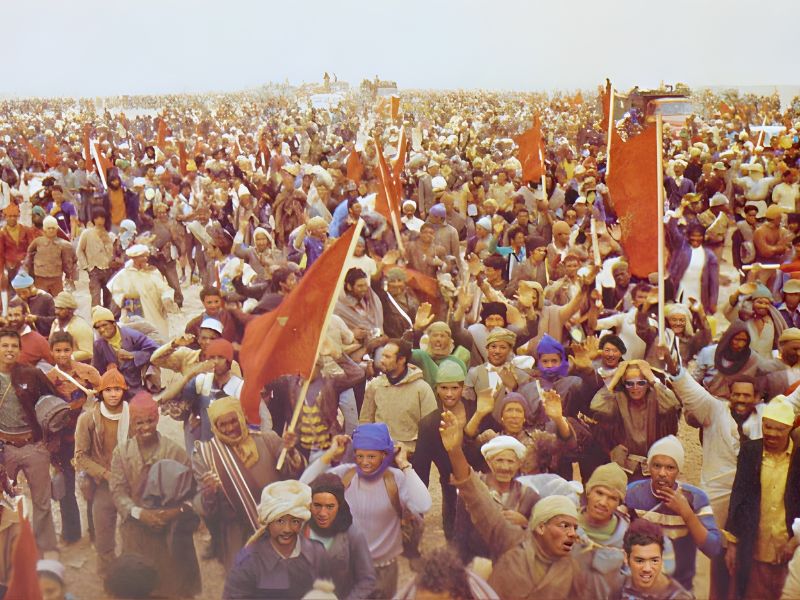
- The Number and the Symbol: The King called upon 350,000 civilian volunteers (men and women) to participate. This number represented the determination of the Moroccan people.
- The Weapon of Peace: The March was to be totally peaceful. The marchers were armed only with national and religious symbols: the National Flag, the Quran, and portraits of the King. The choice of the color green symbolizes Islam and peace.
- Faith and Logistics: The logistics were colossal. Volunteers from all regions of the Kingdom, from Tangier to Agadir, converged on the city of Tarfaya (in southern Morocco), driven by an unwavering faith in the righteousness of their cause. The army (the Royal Armed Forces) provided unprecedented logistical support in terms of food, water, and medical care.
3. The Event: November 6, 1975
On November 6, 1975, upon the signal from King Hassan II, the 350,000 volunteers set off.
- A Unique Mobilization: This human tide, advancing into the desert, captivated the world. It was a demonstration of popular will and national unity rarely equaled in modern history for a territorial claim.
- The Crossing: The marchers symbolically crossed the artificial borders, advancing a few kilometers into the territory. The Spanish forces were ordered not to shoot at the unarmed civilians, which successfully avoided bloodshed.
- Objective Achieved: The diplomatic pressure and the demonstration of the Moroccan people’s determination had the desired effect on Spain, which sought to withdraw without a major conflict.
4. Consequences and Legacy
Days after the March began, Spain agreed to negotiate.
- The Madrid Accords: On November 14, 1975, the Madrid Accords were signed between Spain, Morocco, and Mauritania, sealing Spain’s definitive withdrawal from the territory and the transfer of administrative control to Rabat and Nouakchott (Mauritania withdrew in 1979, leaving Morocco in full control of the territory).
- A Symbol of Unity: The Green March has become a foundation of Moroccan national identity. It embodies the power of non-violent resistance and the Nation’s and its people’s unwavering attachment to their territorial integrity.
- A Development Project: Today, the legacy of the Green March continues through the New Development Model for the Southern Provinces, an ambitious plan aimed at turning cities like Laâyoune and Dakhla into major economic and logistical hubs, strengthening the integration of the South with the rest of the Kingdom.
The Green March remains an eloquent example of how faith, patriotism, and unity allowed a major political objective to be achieved through the sole force of peace.

Leave a comment