

Moroccan embroidery embodies rich cultural heritage, reflecting regional diversity, craftsmanship and symbolism. Beyond aesthetics, it preserves traditional techniques, expresses community identity, supports local economies and transmits cultural knowledge.
A vibrant representation of Morocco’s history and soul.
Moroccan embroidery is a textile art form deeply rooted in the country’s history and culture.
Cultural Significance of Moroccan Embroidery
- Historical and Artistic Wealth: Moroccan embroidery is a traditional art passed down through generations, showcasing various regional styles and techniques. This reflects both the artisans’ talent and the country’s diverse cultural heritage.
- Symbolism and Rituals: Embroidery plays a significant role in Moroccan rituals and celebrations. It often adorns wedding garments, festive clothes, and other special occasion attire. This symbolism embodies community identity and heritage.
- Expression of Identity: Each motif and technique tells a local story or shows mythology. These textiles are a means of cultural expression. They strengthen community belonging.
- Economy and Craftsmanship: Embroidery contributes to local economies by supporting artisans, attracting tourism and providing sales opportunities for embroidered products.
- Transmission of Know-how: The practice preserves traditional craftsmanship for younger generations.
In summary, Moroccan embroidery transcends simple textile decoration; it embodies essential cultural and social richness in Morocco.
Moroccan embroidery encompasses various styles, each reflecting regional characteristics, cultural influences and historical traditions. Here are some prominent types:
Traditional Styles
Rabati embroidery (Rabat): Intricate, fine stitches, often featuring floral patterns. To learn more details, read the article about Rabat embroidery.
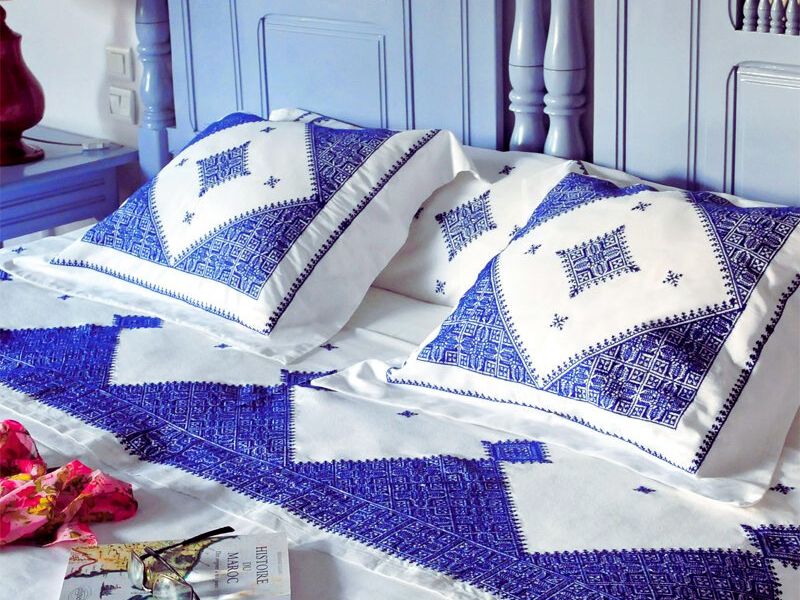
Fassi embroidery (Fez): Geometric patterns, arabesques and epigraphy. If you would explore this type of embroidery, read the article about Fez embroidery.
Tetouani embroidery (Tetouan): Delicate, floral designs, influenced by Andalusian art. The embroidery of Tetouan is very special and unique.
Meknes embroidery: Combines geometric and floral motifs.
Zemmouri embroidery (Azemmour): Geometric patterns (Triangles, squares, diamonds and dragons). The embroidery of Azemmour is one of the treasures of Moroccan crafts.
Amazigh (Berber) embroidery: Symbolic, geometric patterns reflecting tribal heritage.
Technique-Based Styles
- Cross-stitch embroidery: Simple, geometric patterns.
- Satinstitch embroidery: Smooth, shiny appearance.
- Couching embroidery: Raised, decorative stitches.
Traditional Moroccan embroidery embellishes women’s clothing. This includes the Caftan (long traditional dress) and Kettafiya (Scarf). These garments feature intricate gold and silk thread designs.
Skilled artisans, like Fatima DAANOUN, Zohra BENSAID, and Rahma EL OURDANI, preserve this ancient craft. They pass it down through generations.
Moroccan embroidery, once a household tradition, has evolved into a cherished heritage. Social cooperatives and initiatives like Dar Maalma contribute to the promotion of this ancient craft. This network of female artisans shares experiences and showcases handmade creations at annual fairs.
Moroccan fashion designer Fadila el-Gadi pays tribute to her country’s cultural heritage through carefully embroidered clothing. Her collections elegantly blend tradition and modernity.
“I’m proud to showcase the work and passion of Moroccan artisans,” she explains. “Together, we revisit ancestral traditions and adapt them to modern tastes.”
Moroccan embroidery plays a significant role in boosting the local economy. It is especially impactful through traditional clothing like the globally recognized Caftan. This generates value and employment for many.
Moroccan embroidery is an art that deserves to be discovered and appreciated. What do you think of this traditional art? Tell us in the comments!

Leave a comment