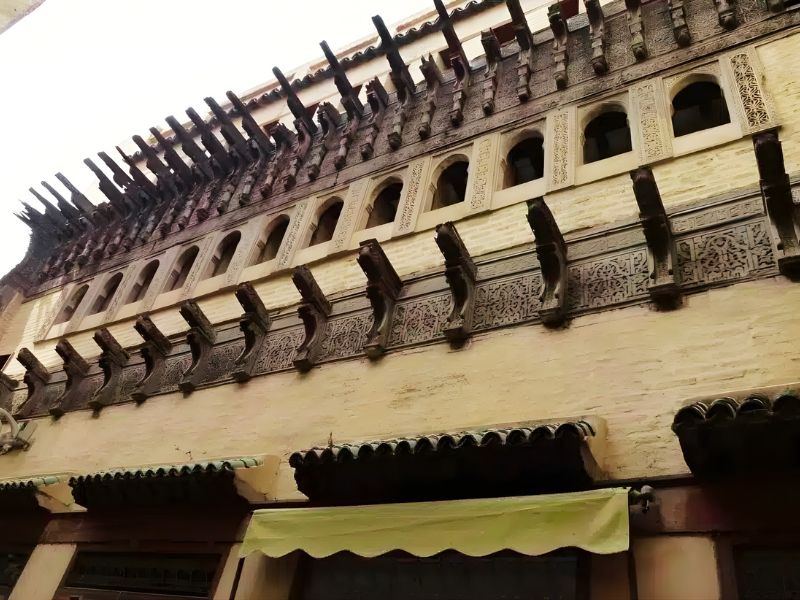

Just across from the magnificent Medersa Bou Inania, on the bustling Tala’a Kebira street, stands a façade that has baffled historians and travelers for centuries. This is Dar al-Magana (The House of the Clock), home to the world’s most famous medieval water clock.
In a city where time often feels like it has stood still, this 14th-century marvel reminds us that Fez was once a global center of science and engineering.
Built in 1357 by the Marinid Sultan Abu Inan Faris, Dar al-Magana is more than just a wall; it is a “time machine” of the Middle Ages. While the clock has been silent for nearly 500 years, its architectural skeleton remains one of the most intriguing sights in the Medina.
⚙️ How did the Water Clock work?
Designed by the muwaqqit (timekeeper) Abu al-Hassan ibn Ali Ahmed el-Tlemsani, the clock used a sophisticated hydraulic and weight-powered system to mark the passage of the hours.
- The Hidden Cart: Behind the twelve windows, a small cart ran along a track, powered by a floating weight in a water reservoir that drained at a perfectly calibrated rate.
- The Hour Bell: As each hour passed, the cart triggered a mechanism: one of the twelve small doors would swing open, and a metal ball would drop—clang!—into one of the thirteen brass bowls sitting on the wooden rafters below.
- Visual and Audio: This allowed the people of Fez to both hear the hour and see exactly how many hours had passed based on which window was open.
🏮 Why was it created?
The clock wasn’t just a display of wealth; it was a functional necessity for the Medersa Bou Inania and its mosque across the street.
- The Call to Prayer: In an era before wristwatches, the clock allowed the Muezzin to know the exact moment for the five daily calls to prayer with mathematical precision.
- A Symbol of Knowledge: It served as a monument to the Sultan’s patronage of the “Exact Sciences” (astronomy and mathematics), showing that Fez was a city where faith and science worked in perfect harmony.
🧭 What can Tourists explore today?
At Dar al-Magana
While the internal mechanism is currently under a long-term restoration process, the façade is a masterpiece of Marinid craftsmanship.
- The 12 Windows: Look for the thirteen (historically twelve active) arched windows and the carved cedar rafters that once held the brass bowls.
- Intricate Stucco: Examine the carved plaster and “arabesque” motifs that decorate the window frames—a sign of the building’s royal importance.
In the Surrounding Area (Fez el-Bali)
Dar al-Magana is located at the epicenter of the most historic part of the city:
- Medersa Bou Inania: Step inside the school across the street to see the finest zellij (mosaic) and carved cedar wood in the world. It is one of the few active religious sites non-Muslims can enter.
- Bab Boujloud (The Blue Gate): Just a few minutes’ walk away, this iconic gate marks the entrance to the old Medina.
- The Tala’a Kebira: Walk this main artery to experience the sensory overload of the spice, textile, and artisan souks.

Leave a comment