
Before Marrakesh became the “Red City,” and long before the Koutoubia minaret dominated the horizon, there was Aghmat. Situated in the lush foothills of the High Atlas, this archaeological treasure was the first capital of the Almoravid Empire and a sophisticated center of medieval Moroccan life.
Today, Aghmat is a silent witness to the birth of a dynasty, offering a hauntingly beautiful look at the foundations of the Moroccan state.
Located just 30 kilometers southeast of Marrakesh, near the modern village of Ghmate in the Ourika Valley, Aghmat was once the most important city in southern Morocco. It served as a vital crossroads for the trans-Saharan trade routes, linking the gold mines of West Africa to the Mediterranean.
📜 A Legacy of Power and Exile
Aghmat’s history is a blend of imperial glory and poetic tragedy.
- The Almoravid Conquest: In 1058, the Almoravids (a puritanical Berber movement) captured the city, making it their strategic base before the founding of Marrakesh in 1062. Even after the capital moved, Aghmat remained a city of high culture and wealth.
- A Royal Prison: The city became the place of exile for the fallen kings of Al-Andalus (Muslim Spain). The most famous was Al-Mu’tamid ibn Abbad, the poet-king of Seville. He and his wife, I’timad ar-Rumaikiyya, lived out their final days here in poverty, a stark contrast to their former palaces in Seville. Their tomb remains a place of pilgrimage for lovers of Arabic poetry.
🏛️ What to Explore Today: The Archaeological Park
Recent excavations have transformed Aghmat into one of Morocco’s most significant archaeological sites. Unlike the busy souks of Marrakesh, Aghmat offers a peaceful, scholarly atmosphere.
- The Great Mosque: Excavations have revealed the footprint of a massive 11th-century mosque, featuring an innovative maqsura (a screened area for the ruler) that could be moved on a mechanical track—a marvel of medieval engineering.
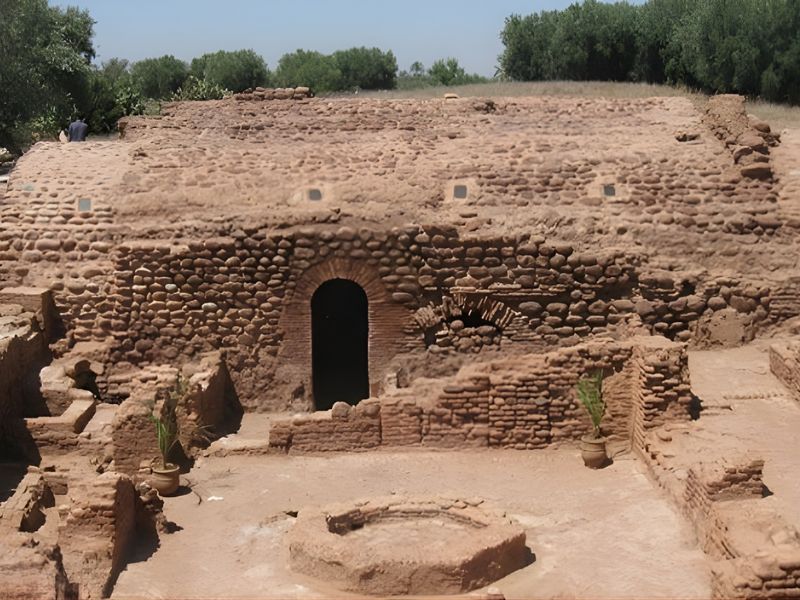
- The Royal Hammam: One of the best-preserved medieval baths in the Islamic world. You can walk through the hot, warm, and cold rooms and see the intricate brickwork and water channels that once provided luxury to the Almoravid elite.
- The Palatial Complex: Explore the foundations of grand houses and administrative buildings that prove Aghmat was a city of gardens, fountains, and immense architectural ambition.
🏔️ The Setting: Foothills of the Atlas
The location of Aghmat is as spectacular as its history. It sits at the mouth of the Ourika Valley, where the cool mountain air meets the plains of the Haouz. Visitors are surrounded by olive groves and orchards, with the snow-capped peaks of the High Atlas providing a dramatic backdrop.

Leave a comment