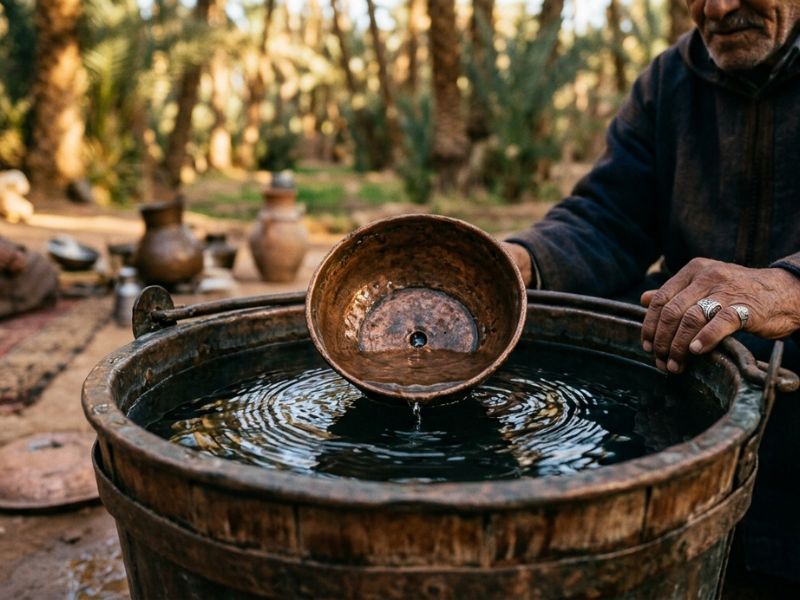

In the scorched valleys of the Tafilalet and the Draa, where every drop of water is a victory over the desert, lies a masterpiece of social and mechanical engineering. While modern pumps rely on diesel and electricity, the ancient oases of Morocco have survived for centuries using the “Clepsydra” or Water Clock—a communal distribution system that is as much about mathematical precision as it is about human harmony.
This is the story of how a simple bowl and a bucket of water created a civilization.
In the traditional Moroccan oasis, water is not owned; it is shared. To manage the flow from the Khettaras (underground canals) to the individual plots of farmers, the “Water Clock” (Tanast) was perfected. It ensured that whether you were a wealthy landowner or a small-scale gardener, you received your exact, fair share of the “Liquid Gold.”
⚙️ The Mechanics: How the Tanast Works
The system is deceptively simple and remarkably accurate. It consists of two primary elements: a large copper bucket (el-Kaba) filled with water, and a smaller, perforated copper bowl (el-Tanast).
- The Sinking Bowl: The small bowl has a tiny, precisely calibrated hole in its base. It is placed on the surface of the water in the larger bucket.
- The “Hour”: As water seeps through the hole, the bowl slowly sinks. The moment the rim disappears beneath the surface and the bowl hits the bottom, one unit of time—often called a Ghous—has passed.
- The Distribution: A designated official, the Amine n’Ouman (Master of the Water), keeps track of these units. For every Ghous that passes, the water gates (ouqbats) are opened to a specific farmer’s field using a system of stone and mud diversions.
🤝 Social Engineering: The Rule of the Master
The water clock is more than a tool; it is a legal and social framework.
- The Amine n’Ouman: This elected official is the “Judge of the Water.” He must be a person of impeccable integrity, as he is responsible for the survival of the village. He sits by the clock day and night during the irrigation cycle.
- The Knot Record: To keep track of the turns, the Amine uses a palm fiber rope. Every time the bowl sinks, he ties a knot. This physical “ledger” ensures that there is no dispute about how much water has been delivered to each family.
🌿 The Engineering of the Khettara
The water clock only works because of the Khettara—a network of underground galleries that bring water from the water table to the oasis via gravity.
- Evaporation-Proof: By keeping the water 10 meters underground, the system prevents the brutal Saharan sun from stealing the moisture.
- The Vertical Shafts: You can see these from the air—long lines of “eye-like” mounds in the desert. These are the access shafts used by the Muallimeen (master diggers) to maintain the tunnels.

Leave a comment