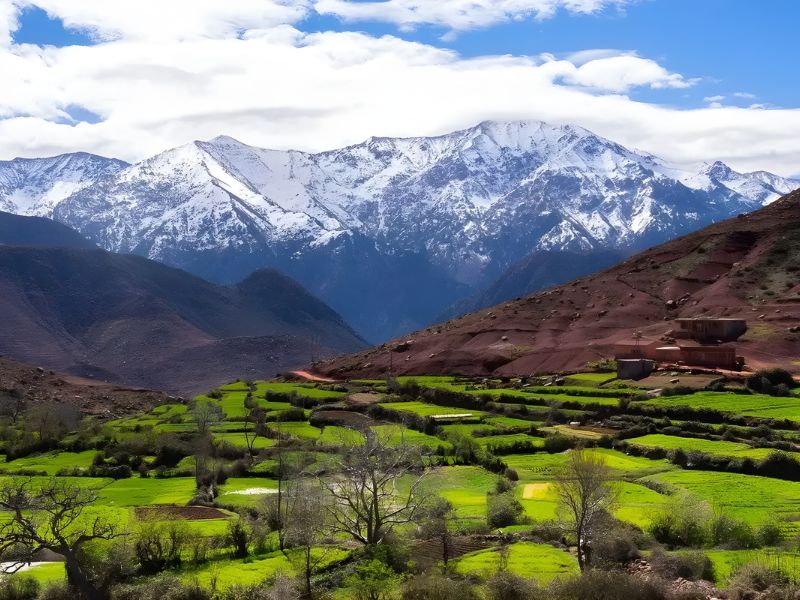

The High Atlas Mountains, or Idraren Draren (“The Mountains of Mountains”) in the local Tamazight language, form the majestic backbone of Morocco. This isn’t just a mountain range; it is a world of sky-piercing peaks, hidden Berber villages carved into red rock, and lush valleys that defy the surrounding desert.
From the snow-capped summit of Toubkal to the fragrant gardens of the south, the High Atlas offers a journey into the primal heart of North Africa.
Stretching over 740 kilometers, the High Atlas separates the Mediterranean and Atlantic coastlines from the Saharan sands. It is a landscape of dramatic contrasts where 4,000-meter peaks overlook palm-filled oases.
🥾 The Peaks of Adventure: Imlil & Mount Toubkal
For hikers and mountaineers, the village of Imlil is the undisputed starting point.
- Mount Toubkal (4,167m): The highest peak in North Africa. Reaching the summit is a rite of passage, offering a panoramic view that, on a clear day, stretches all the way to the Sahara.
- The M’Goun Massif: For those seeking a wilder, less-crowded trek, the central High Atlas offers ridges and deep gorges that feel truly untouched by time.
🌹 The Valleys of Color: Ourika, Oukaimeden, and the Rose Valley
Each valley in the High Atlas has its own “personality” and seasonal magic.
- Ourika Valley: A favorite escape for those in Marrakesh. Known for its seven waterfalls at Setti Fatma and its vibrant riverside restaurants where you can dine with your feet literally in the cool mountain water.
- Oukaimeden: Africa’s highest ski resort. In the winter (January–March), you can ski on slopes overlooking the burning plains of the Haouz.
- The Rose Valley (Kelaat M’Gouna): As we’ve explored, this valley turns pink every April and May. It is the center of Morocco’s Damascus Rose industry and a sensory wonderland.
🏰 The Gateway Cities & Earth-Built Villages
The High Atlas is home to some of Morocco’s most iconic architectural wonders.
- Aït Benhaddou: A UNESCO World Heritage ksar (fortified village) that has starred in countless films, from Gladiator to Game of Thrones. Its red-clay towers are a masterpiece of earthen architecture.
- Telouet Kasbah: Once the palatial seat of the “Lords of the Atlas” (the Glaoui family), this crumbling fortress hides some of the most intricate zellij and stuccowork in the country.
- The Tizi n’Tichka Pass: The legendary road connecting Marrakesh to Ouarzazate. Reaching 2,260 meters, it offers some of the most hairpin-turning, breathtaking vistas in the world.
🏺 The Soul of the Atlas: Berber Hospitality
The true attraction of the High Atlas isn’t the stone, but the people. The Amazigh (Berber) tribes have lived here for millennia.
- The Weekly Souks: In villages like Asni, the weekly market is the heartbeat of the mountains—a place of trade, news, and the scent of roasting lamb.
- Village Life: You will see houses built from the very earth they stand on, terraced fields of barley and walnuts, and a level of hospitality where a stranger is always a “guest of God” invited for mint tea.

Leave a comment