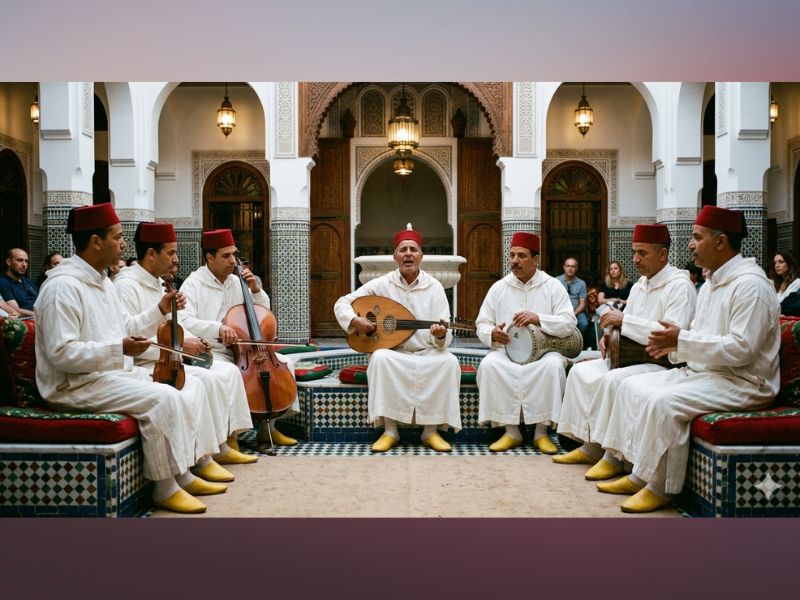

In the heart of Morocco’s imperial medinas, where the rhythmic tapping of copper-smiths and the scent of cedarwood define the air, a sound exists that bridges the gap between the mundane and the divine. This is Almalhoune (or Malhun).
Recently enshrined on UNESCO’s Intangible Cultural Heritage list, Malhun is far more than music; it is Morocco’s collective memory set to melody. It is the “Poetry of the People,” a sophisticated urban art form that proves you do not need a palace to create a masterpiece.
Almalhoune literally translates to “the melodic poem.” While many associate it with the later urban guilds, its true roots delve much deeper into the Moroccan soil than previously thought.
🏺 A Legacy of Eight Centuries: The Almohad Origins
Contrary to the common belief that Malhun began in the 15th century, historical scholarship and oral tradition trace its genesis back to the 12th century during the Almohad Dynasty.
- The Oasis Cradle: It first blossomed in the Tafilalet region and the Draa Valley. Under the Almohads—a dynasty known for its rigorous intellectualism and architectural grandeur—this poetic form began as a way for the common people to express spiritual and social truths in their own tongue.
- The Language of the Soul: While the elite wrote in Classical Arabic, Malhun was the first major art form to elevate Zajal (colloquial poetry) and Darija. It allowed the Moroccan identity to flourish, blending Arab poetic structures with the indigenous Amazigh soul.
🛠️ The “Working Class” Conservatory
As the centuries progressed, Malhun migrated from the southern oases to the urban centers of Fez, Meknes, and Marrakesh. It was here, within the artisanal guilds, that the art form reached its peak refinement.
- The Masters of the Souk: The great poets (Chioukhs) were not full-time musicians; they were weavers, tanners, and cobblers. By day, they worked with leather and silk; by night, they wove intricate metaphors.
- The “L’ghit”: This is the gathering where Malhun is performed. It is an intimate, democratic space where a master artisan and a simple apprentice sit side-by-side, united by the power of the word.
🥘 A Living Encyclopedia: Themes of the Malhun
A single Malhun poem, or Qasida, can last for over an hour and cover an astonishing range of human experience:
- The Mystical (Tawassul): Deeply Sufi in nature, these poems are pleas to the Divine, often used to open a performance with spiritual cleansing.
- The Romantic (Ghazal): Celebrations of beauty and love, often using the metaphor of the “Wax” (Sham’a) or the “Messenger” (Harraz).
- The Gastronomic: Some Qasidas are dedicated entirely to the description of Moroccan feasts, serving as a historical record of traditional recipes and ingredients.
- The Political: Throughout history, Malhun has been used as a tool for social commentary and resistance against colonial or unjust influences.
🧭 The Al-Andalus Connection: Heritage Refined
Though born in the Moroccan South, Malhun is the greatest guardian of the Andalusian legacy. Following the Reconquista, the sophisticated music and poetry of Al-Andalus found a home in Morocco. Malhun adopted the complex melodic modes (Tubú) of Andalusian music but kept its feet firmly planted in the Moroccan street. It is the “bridge” between the elite classical orchestras and the heartbeat of the people.

Leave a comment