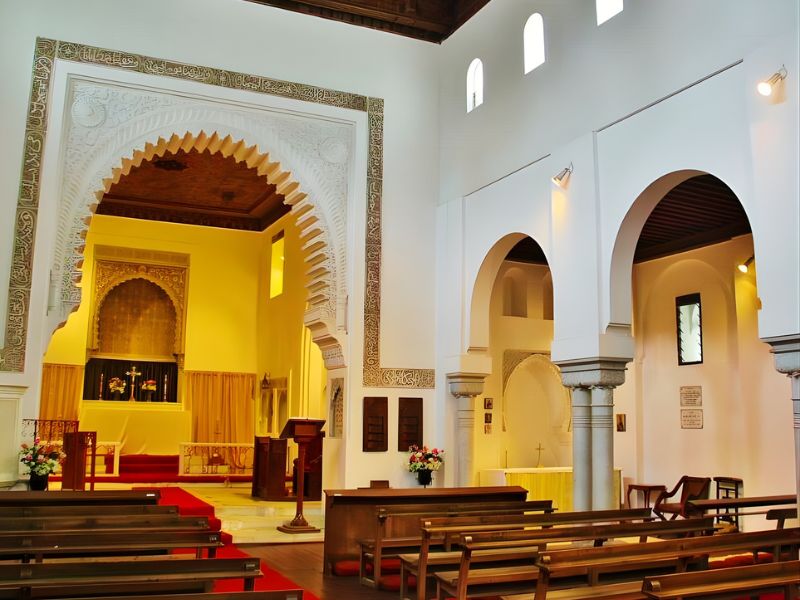

In the heart of Tangier, where the narrow streets of the Medina meet the colonial elegance of the Ville Nouvelle, lies a hidden courtyard that defies all architectural expectations.
St. Andrew’s Anglican Church is one of the most remarkable religious sites in the world. At first glance, it appears to be a traditional Moroccan mosque, but once you step inside, you find a sanctuary where the Anglican liturgy is housed within a masterpiece of Moorish design. It is a profound symbol of Tangier’s historic religious tolerance and its cosmopolitan soul.
Consecrated in 1894 on land gifted by Sultan Hassan I, St. Andrew’s was built to serve the growing British community in Tangier. However, the Sultan’s gift came with a unique cultural spirit: the church was built using the skills of local Moroccan craftsmen, resulting in a “Moorish-Christian” hybrid that exists nowhere else on earth.
🏺 A Masterpiece of “Cross-Cultural” Architecture
The interior of St. Andrew’s is a breathtaking exercise in Islamic art used for Christian worship:
- The Chancel & Altar: Instead of traditional Gothic carvings, the area behind the altar is decorated with intricate Zellij tiles and delicate Stucco (carved plaster) that you would typically find in a grand Alhambra palace.
- The Lord’s Prayer in Arabic: Perhaps the most famous feature is the archway above the altar. Beautifully inscribed in Kufic Arabic script are the words of the Lord’s Prayer. For many visitors, seeing the central prayer of Christianity written in the sacred script of Islam is a deeply moving experience.
- The Minaret-Style Bell Tower: The church’s tower is modeled after the square minarets of the Almohad dynasty, allowing it to blend seamlessly into the Tangier skyline.
- Facing Mecca: In a final nod to its location, the church is oriented toward the East, with its mihrab-style alcove ironically pointing toward Mecca.
📍 Exploring the “Graveyard of Legends”
The cemetery surrounding the church is a quiet, overgrown paradise of palms and bougainvillea, serving as the final resting place for the legendary “characters” of Tangier’s International Zone era:
- Walter Harris: The famous Times correspondent and author of Morocco That Was, who lived a life of high adventure among Sultans and bandits.
- Sir Harry MacLean: The Scottish soldier who became the commander of the Sultan’s army, known for playing bagpipes in the Moroccan desert.
- The Fallen Soldiers: Rows of headstones mark the young men of the Commonwealth who lost their lives in the region during World War II, a somber reminder of the city’s strategic importance.
🕊️ A Living Sanctuary
St. Andrew’s is not just a museum; it remains an active place of worship. The current caretaker, often a local Moroccan, is a font of knowledge and embodies the spirit of interfaith harmony that has defined this church for over 130 years.

Leave a comment