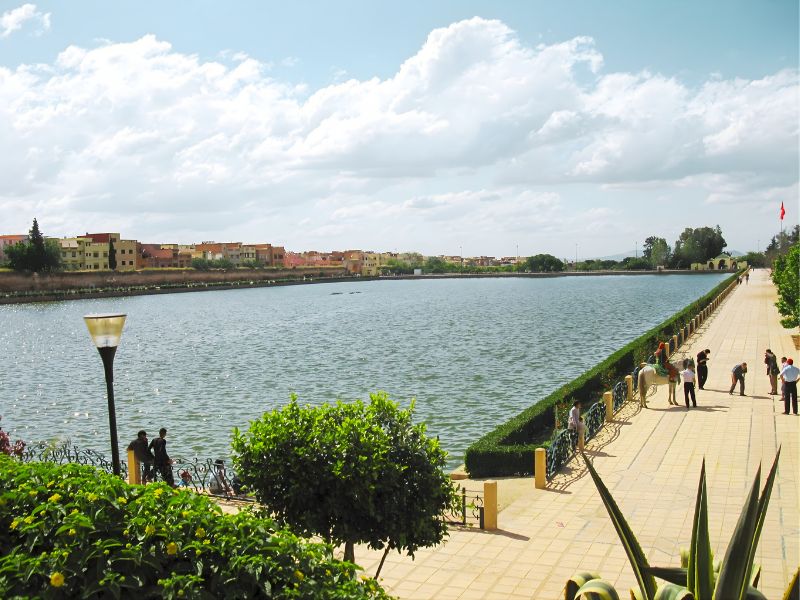

In the 17th century, Sultan Moulay Ismail didn’t just want a city; he wanted a kingdom that could breathe and survive any siege. To achieve this, he created the Agdal Basin (Sahrij Swani)—a massive engineering feat that served as the liquid heart of Meknes.
While it is often referred to as a “basin,” it is more like an artificial lake of grand proportions, reflecting the golden walls of the Imperial City and the ambitions of an emperor.
Measuring roughly 300 meters long and 150 meters wide, the Sahrij Swani (Basin of the Norias) is an architectural marvel that sits directly in front of the massive Heri es-Souani granaries.
🏺 More Than Just a View: The Survival Engine
The basin was not merely ornamental; it was the centerpiece of a sophisticated hydraulic system:
- The Strategic Reservoir: The basin held enough water to irrigate the sprawling royal gardens and provide drinking water for the Sultan’s legendary 12,000 horses and his vast army, even during times of severe drought or war.
- The Noria System: Originally, ten massive waterwheels (norias) surrounded the basin, driven by animals to lift water from the subterranean channels into the reservoir.
- Military Drills: Legend has it that the Sultan used the basin to train his elite naval troops and that his harem would enjoy boat rides across its tranquil surface on summer evenings.
🌅 The Social Heart of Modern Meknes
Today, the Agdal Basin has transformed from a military asset into the city’s favorite gathering place.
- The Sunset Stroll: As the sun dips behind the walls of the Imperial City, the basin becomes a vibrant social hub. Families, students, and travelers gather along its banks to enjoy the cooling breeze and the reflection of the Heri es-Souani in the water.
- Local Life: You’ll see traditional street food vendors selling popcorn and chickpeas, local musicians practicing Gnaoua rhythms, and the occasional horse-drawn carriage (koutchi) trotting past, adding to the timeless atmosphere.

Leave a comment