
In the 17th century, Sultan Moulay Ismail dreamed of an empire that would rival the greatest powers of Europe. To fuel this dream, he needed an army, and to power his army, he needed horses.
Enter Heri es-Souani (The Granaries of the Sultan). Located just a short distance from the royal palace in Meknes, this architectural giant is often called the “Stables of the Sultan.” It is a place of staggering scale, designed to feed a kingdom and house a legendary cavalry of 12,000 stallions.
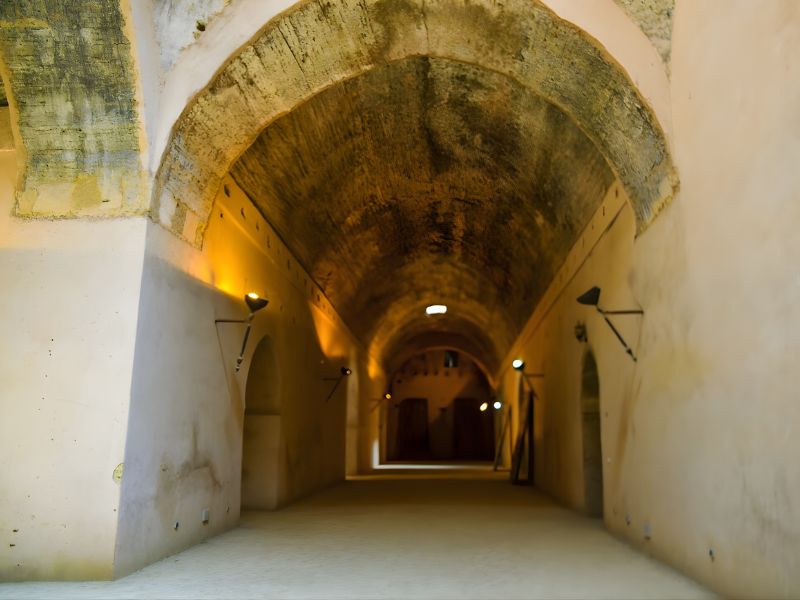
Walking into the massive vaults of Heri es-Souani, you are immediately struck by the engineering genius of the Alawite era. This wasn’t just a warehouse; it was a high-tech climate-controlled facility centuries before electricity.
🏺 Engineering the “Eternal Cool”
The most impressive feature of the granaries is the natural air conditioning system:
- The Massive Walls: The exterior walls are over 4 meters thick, made of pisé (rammed earth) and stone, providing incredible insulation against the scorching Meknes sun.
- The Underground Water: Beneath the floors lies a complex network of channels and waterwheels (souani) that drew water from deep wells. This constant flow of water kept the grain and the horses cool, even in the dead of summer.
- The Ceiling Design: The high, vaulted ceilings allowed hot air to rise and escape, maintaining a stable temperature that prevented the grain from rotting.
🏰 The Cathedral of Arches
The structure is divided into two distinct sections:
- The Indoor Granaries: A series of 23 massive, vaulted rooms where grain was stored in such quantities that it could feed the city during a multi-year siege.
- The Open-Air Stables: Behind the granaries lie the remains of the stables. Today, the roof has largely collapsed—likely due to the 1755 Lisbon earthquake—leaving behind a hauntingly beautiful forest of stone arches that stretch toward the horizon. Standing here, you can almost hear the thunderous echo of 12,000 royal horses.
💧 The Basin of Agdal
Directly outside the granaries lies the Agdal Basin (Sahrij Swani). This massive 4-hectare artificial lake served as the water reservoir for the royal gardens and the horses. Today, it is a peaceful spot where locals stroll and enjoy the reflection of the imperial city in the water.

Leave a comment