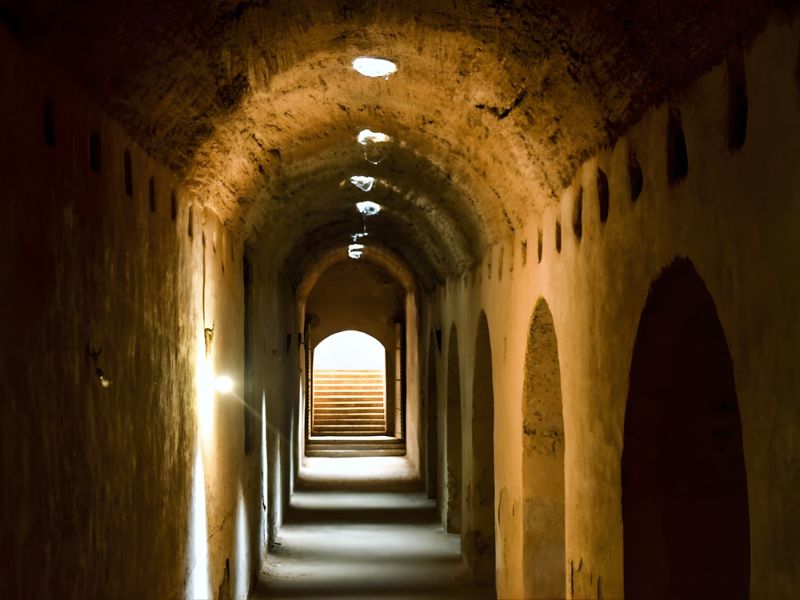

Beneath the sun-drenched stones of Meknes’ imperial district, right next to the diplomatic pavilion where ambassadors once negotiated the fate of captives, lies a world of eternal shadow.
The Prison of Qara (Habs Qara) is one of the most mysterious and chilling sites in Morocco. Part history, part urban legend, this subterranean labyrinth is a must-visit for those who want to see the dark side of Sultan Moulay Ismail’s “Versailles of Morocco.”
Known as the “Prison of the Christians,” this vast network of vaults sits quietly beneath the feet of thousands of tourists who walk across the square above. It is a monument to the absolute power of an emperor and the ingenuity of the prisoners who built it.
🏺 Architectural Mystery: A Labyrinth with No Doors
The most terrifying aspect of the Prison of Qara is its design. Unlike modern prisons, it was built without bars or cells.
- The No-Door Design: The prison was built as a giant, dark maze. It is said that no doors or locks were necessary because once inside, the complex geometry and total darkness made escape an impossible feat.+1
- The Sky Holes: If you look at the floor of the plaza above, you will see small, square openings covered by iron grates. These were the only sources of light and air, and more importantly, the only way in. Captives were literally “dropped” into the prison from above.+1
- The Architecture of Weight: The vaults are supported by massive stone pillars (1.4m by 3.5m). These columns were engineered so strongly that they still support the weight of the city, including heavy vehicles and buildings, without a single crack after 300 years.
🎭 The Legend of the Architect
The prison is named after Qara, a Portuguese prisoner. Legend has it that Sultan Moulay Ismail made a high-stakes deal with him: if he could build a prison capable of holding 40,000 inmates, he would be granted his freedom. Qara succeeded, but the “Victorious Renegade” was supposedly never seen again—leaving behind a structure that some claim stretches all the way to the city of Taza, 100km away.+2
👻 Modern Myths & Disappearances
The prison is a magnet for “dark tourism.” In the 1990s, a team of French explorers reportedly entered the deeper levels of the tunnels and never emerged. Following this incident, the Moroccan authorities sealed off large portions of the labyrinth with concrete walls. Today, only three massive halls are open to the public, though the air still feels heavy with the secrets of the thousands who were once held below.

Leave a comment