

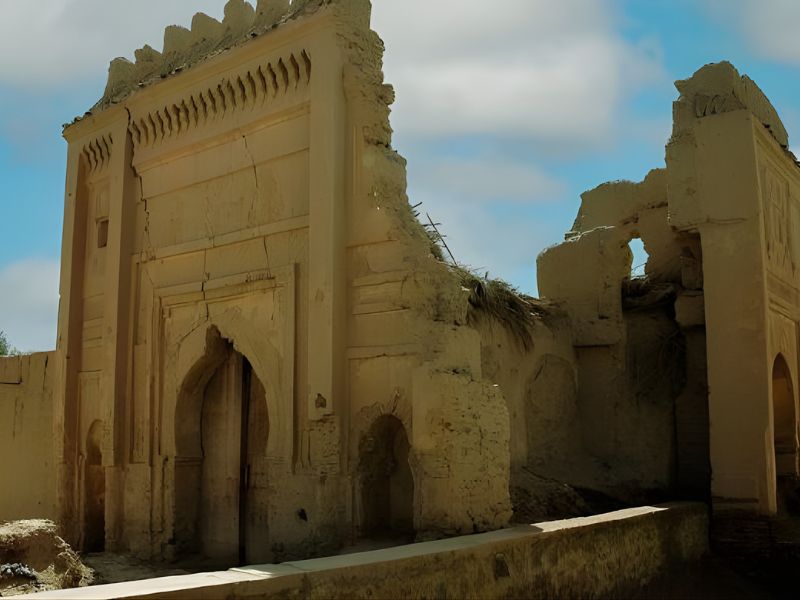
For centuries, before Marrakech was even a thought, the true pulse of power and commerce in North Africa beat fiercely in the desert. That pulse belonged to Sijilmasa, a legendary medieval city that served as the definitive crossroads of the trans-Saharan trade route. Today, only sprawling, earth-colored ruins remain near modern Rissani, yet walking through this vast, silent archaeological site is one of the most powerful historical experiences Morocco offers.
Sijilmasa is a testament to the fact that immense wealth and imperial dreams were once built on the sand.
📜 The Historical Zenith: A Medieval Powerhouse
Sijilmasa was not just a trading post; it was a sovereign city-state that, at its peak, housed tens of thousands of residents.
1. The Gateway to Gold (8th to 14th Century)
- Foundation and Location: Founded in the mid-8th century by the Miknasa Berbers, Sijilmasa quickly became the most important settlement in the Tafilalt oasis. Its strategic location made it the perfect northern terminus for the trade network connecting North Africa to the rich gold fields and empires of West Africa (like Ghana and Mali).
- The Currency of Wealth: The city’s wealth was built on two primary commodities: Gold (from the south) and Salt (from the north). It was here that gold dust was refined, weighed, and stamped before being transported north to the Mediterranean and Europe. This control over the gold supply gave Sijilmasa immense political and economic leverage.
- A Center of Learning: Beyond trade, Sijilmasa was renowned as a center of learning, attracting scholars, poets, and mathematicians, making it a cultural beacon in the western Islamic world.
2. The Dynastic Crossroads
The city’s decline often mirrored the rise and fall of major Moroccan dynasties:
- Almoravids and Almohads: Sijilmasa was incorporated into the great Berber empires, the Almoravids and Almohads, but its power was often coveted and contested.
- The Marinid Era: It enjoyed periods of renewed prosperity under the Marinid Dynasty before facing increasing instability due to internal conflicts and shifts in trade routes.
- The Alawite Link: Though Sijilmasa was in decline by the 17th century, its legacy directly influenced the Alawite Dynasty. The Alawite Sharifs, including Moulay Ali Cherif, established their initial spiritual and territorial base nearby in the Tafilalt oasis, inheriting the region’s prestige and its position on the trans-Saharan routes.
🔎 What to See at the Ruins
Today, Sijilmasa lies 3 km north of modern Rissani. Visiting the site requires imagination, but the scale of the remains is awe-inspiring.
- Vast Scale: The site covers approximately five miles (8 km) of mounds and foundations. You can walk through the remains of former residential quarters, fortifications, and administrative areas.
- The Foundations: The ruins are composed mainly of dried mud-brick (pisé) foundations. The elements have taken their toll, reducing walls to massive, earthen ridges. You can clearly trace the outline of the old city walls and defensive structures.
- The Museum: While the ruins themselves are sparse, a small museum complex is often situated nearby (near the Mausoleum of Moulay Ali Cherif in Rissani), showcasing archaeological finds from Sijilmasa, including ceramics, coins, and tools, to help visitors visualize the city’s complex life.
🧭 Visiting Sijilmasa Today (Practical Tips)
- Location: The site is easily accessible by taxi or foot from Rissani.
- The Experience: This is an experience for the historically curious. Because the site is largely unexcavated and unprotected, it is best visited with a local guide who can help interpret the low mounds and identify the former gates, houses, and marketplaces based on oral tradition and historical maps.
- Timing: Visit early in the morning or late afternoon to avoid the intense midday desert heat.
Sijilmasa is a powerful reminder of a time when the desert was not a barrier but the very source of Morocco’s wealth and global connection. It is the silent, dusty prelude to the modern city and a mandatory pilgrimage for any traveler seeking the true depth of Moroccan history.

Leave a comment