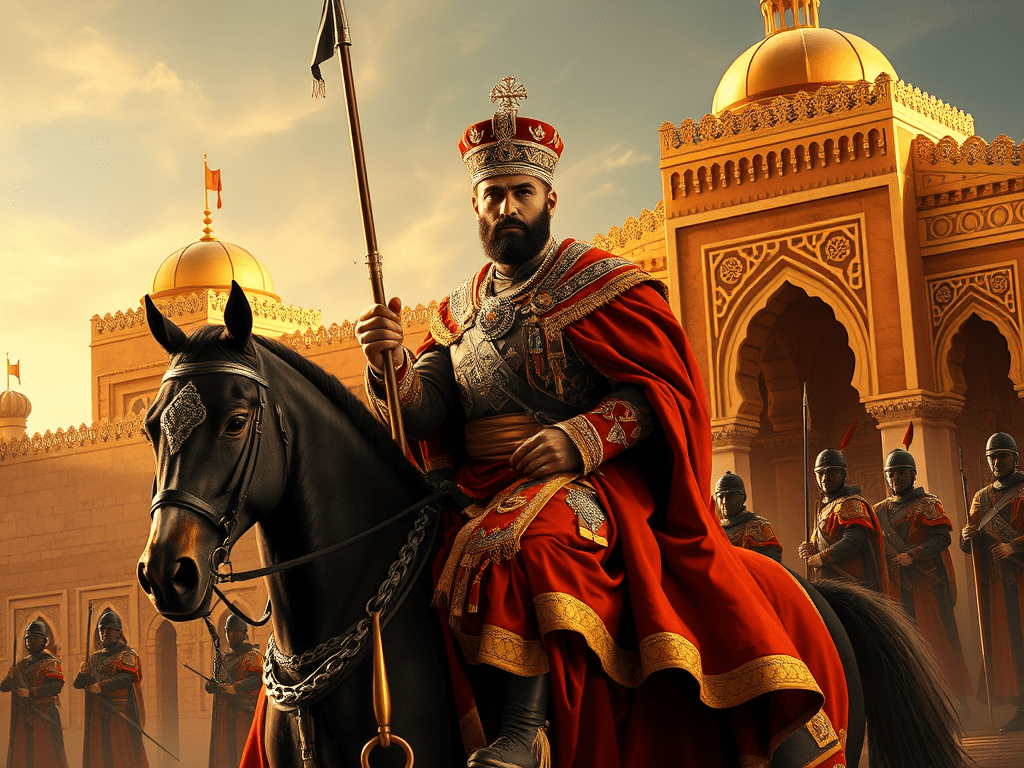

In the history of Morocco, few figures loom as large or reigned as long as Sultan Moulay Ismail Ben Cherif (r. 1672–1727). Building upon the foundation laid by his father, Moulay Ali Cherif, Ismail emerged from the chaos of the mid-17th century to become the undisputed, absolute ruler of Morocco for an astonishing 55 years. His reign marks the definitive period of consolidation for the Alawite Dynasty and forged the centralized state that largely endures today.
1. The Ascent to Absolute Power
When Moulay Ismail inherited the throne, Morocco was still highly fractured, plagued by rebellious regional qaids (governors), powerful religious brotherhoods, and foreign encroachments along the coast.
- Unification by Force: Ismail’s first task was to destroy all internal dissent. He spent the first two decades of his rule ruthlessly subduing rebels in the Atlas Mountains, the Dila Brotherhood, and establishing central control over regions that had enjoyed decades of autonomy.
- The Black Guard (Abid al-Bukhari): Recognizing the unreliability of tribal militias, Ismail created his legendary permanent standing army, the Abid al-Bukhari (Servants of Al-Bukhari). This army, composed primarily of slaves and soldiers of sub-Saharan African descent, was fanatically loyal to the Sultan and instrumental in crushing internal revolts and driving out European forces.
2. A Reign of Imperial Ambition and Diplomacy
Moulay Ismail’s rule was characterized by dual goals: asserting national sovereignty against foreign powers and engaging in sophisticated international diplomacy.
Driving Out the Europeans
Ismail waged successful campaigns to reclaim coastal cities from European occupation:
- Larache and Mehdia: He recovered Larache from Spain in 1689.
- Tangier: He successfully drove the English out of Tangier in 1684.
These military victories secured Morocco’s strategic coastline and solidified his image as a powerful Islamic leader defending the Dar al-Islam.
Global Diplomacy
Ismail maintained diplomatic relations with several major European courts, including those of France (King Louis XIV), England, and Spain.
- The Captive Exchange: A significant part of his foreign policy involved the exchange of European captives (taken by Barbary corsairs, often operating out of Salé) for political and economic concessions. He used these exchanges as leverage to secure trade agreements and obtain military supplies.
3. The Grand Architectural Legacy: Meknes
Moulay Ismail needed a capital that reflected his absolute power, and he chose the city of Meknes.
- A New Imperial City: He undertook massive construction projects, turning Meknes into an immense imperial city designed to rival Versailles.
- Vast Scale: The city included colossal walls, stables said to house 12,000 horses, granaries (Herri es-Souani), and expansive palaces. Much of the building material was reportedly sourced from the ruins of the Saadian capital, Marrakech, symbolizing the complete shift of power.
- Bab Mansour: His most famous architectural legacy is the stunning Bab Mansour gate, renowned for its intricate tilework and grand scale, standing as a permanent testament to the Sultan’s ambition.

4. The Challenges and Enduring Legacy
Moulay Ismail’s long reign brought stability but was not without its costs and controversies.
- Succession Crisis: His death in 1727 triggered a prolonged and violent period of succession, as the loyalty of the powerful Abid al-Bukhari army shifted into a chaotic political force, leading to decades of instability among his many sons.
- The Iron Sultan: He was known for his extreme authoritarianism and strict enforcement of the law, earning him a reputation for being the “Iron Sultan.” His ability to impose a unified order across Morocco, however, was his most enduring political success.
Moulay Ismail is remembered as the great consolidator of the Alawite Dynasty. He transformed a fragmented state into a formidable imperial power, secured its borders, and left behind an architectural legacy in Meknes that embodies the sheer scale of his singular, powerful vision.
Want to visit the monuments he left behind? as they are a testament to his power. Moulay Ismail’s ambition remains carved into the very stone of Morocco, most notably in the sprawling ruins and majestic gates of Meknes.
Ready to walk the walls built by the ‘Warrior King’?
Click here for our guide to visiting the Royal Palace Ruins, Bab Mansour, and the Mausoleum of Moulay Ismail in Morocco’s dramatic Imperial City, Meknes.

Leave a comment